Featured

Dunnottar Castle

Visited in April 2018, Dunnottar Castle was one of our first forays into old abodes in Scotland.

The castle is located a couple of miles to the south of Stonehaven, and just off the A92, which is the road that connects the town, Angus and Dundee (hugging the coast). The castle is also easily accessible from the A90, which is generally a quick road to drive.

The name Dunnottar translates from the Gaelic Dùn Fhoithear, or ‘Fort on the shelving slope’. The earliest written records of the site date back to around 681AD, but the remaining buildings were erected in the 15th and 16th century. Strategically situated on the east coast, and well placed for defence, the castle has been prominent in Scottish history, up to and including the Jacobite rebellion.

Undiscovered Scotland provide a detailed account of the history of the castle, plus the importance of its geography.

https://www.undiscoveredscotland.co.uk/stonehaven/dunnottarcastle/index.html

The site has been owned by the Cowdray Family since the 1920s and remains in their possession but run as a visitor site. Their website is https://www.dunnottarcastle.co.uk and has up to date information on tickets and opening times. At the time of writing, adult tickets were £8 while children were £4.

There is a large car park close to the castle (marked with a red pin on the map above) with toilets and food vans on site. While the paths leading up to and within the castle were all well maintained, the path to the site itself is not suitable for wheelchairs, buggies, very small children or those with mobility issues, given the 200 odd steep steps. It’s almost as if the original builders did not anticipate Dunnottar’s later life as a tourist attraction.

A personal point of interest are the large stables within the castle grounds – I would have been very interested to see how the horses and ponies navigated the route up and down!

Dunnottar is a must-visit for anyone with an interest in Scotland’s castles. It’s the perfect mix of history, geography and stunning scenery, which the owners have capitalised upon as a well-run visitor attraction. If you have time, nip down to Stonehaven. We can recommend the Bay Fish and Chip Shop (award-winning!) and Aunty Betty’s (for ice creams as big as your head).

Featured

Torwoodlee Tower

Visited on the 1st of November, 2020, Torwoodlee Tower is tucked away in the woodland just off the A72; a few minutes drive outside of Galashiels.

Built in 1601 and abandoned in 1783, the tower is a ruin that has recently undergone some stabilisation work thanks to input from Historic Enviroment Scotland and other interested parties. Full details of the project and of the history of the site can be found here…plus an artist’s rendering of how the castle may have looked when complete.

http://www.torwoodlee.com/torwoodlee-tower

The site is currently well maintained and at the time of our visit, forestry work roundabout looked recent. Free to enter, but with nothing else to see other than the ruin. The path to the tower was grassy with a slight incline; certainly not suitable for prams/buggies on the day we visited due to the rain making the ground very soft, but anybody steady on their feet would manage.

An information board marks the start of the path down to the tower, and there is space for a few cars to park at the top of the single track lane leading off the A72. There is also layby parking within sight of the turn off, again on the A72.

Dog-friendly? Yes, although close to a busy main road so not suitable if your canine companion is likely to do a runner if let off the lead.

Child-friendly? Nice open space in front of the castle for some frolicking, but a lot of loose rocks and warning signs for falling masonry. Not the best if your kiddie is in the mood to channel their inner-Spider-Man.

Small but quaint, the ruin’s highlights include evidence of fireplaces, the remains of a spiral staircase, lovely grounds and a yew tree believed to be several hundred years old. While perhaps not worthy of a long drive to see the ruin and nothing more, it was a welcome addition to our Borders weekend away.

Scone Palace

Scone Place (pronounced Scoon, rather than Scon!) was one of our very first old abode trips out – way back in April 2018…

The palace is nestled between the village of Scone and the River Tay; easily accessible via the A93 and well signposted in the local area.

Scone has a rich history, the crowning place of the Kings of Scotland from the 9th century and original home to the Stone of Scone, better known as the Stone of Destiny. An abbey originally stood on the site, sacked in 1559 and with little other than foundations to mark the area. The land was sold on, a building to replace the abbey was erected and is common in Scottish history, there were arguments around all of it for a couple hundred years! (Can you tell that this is not my forte?!) The current palace was finished in 1807 with ongoing work to the interior, contents for the extensive galleries and landscaping of the expansive gardens occurring since…

Owned by the Earl of Mansfield, the palace and the gardens are open to the public and an extremely popular Scottish attraction. Visitors can have a tour of parts of the palace, and/or the gardens. We took part in a guided tour and while informative , I got the sense that we only saw a very small part of the palace.

Up-to-date details of tours, opening times, and ticket prices are available on the website – https://www.scone-palace.co.uk – the palace being open for guests start of April until the end of October and the gardens being available up until med-December and from the beginning of February. Tickets (for the palace and the gardens) currently cost £16.50 per adult, or £12 per child.

Talking of the gardens, it was these that really made the trip worthwhile, and it would be easy to lose a morning or an afternoon on a sunny day just wandering around and taking in the scenery – particularly useful when you need to run the legs off a small person!

I hope that the pictures give some sense of scale of just how much room there is to enjoy. Dogs on leads are welcome in the grounds, but bear in mind there are peacocks roaming, who don’t appreciate the attention of loud dogs or curious children…

A short distance from the palace stands a chapel on Moot Hill (above) and although not obvious in the picture, a replica of the Stone of Destiny. Guests are also invited to navigate the popular star-shaped maze, burn off some energy in the outdoor play park, or wander the walled gardens.

Accessibility around the whole area is good – the map above shows the parking in comparison to the palace, and there are disabled spaces available closer to the main building. Paths and tracks are all flat and well-maintained, suitable for buggies and wheelchairs.

We ended a very enjoyable afternoon with hots drinks and scones on the lawn, provided by the cafe which sits at the end of tour. While I (as ever) was more entranced by the scope and scale of the building rather than its contents, Scone Palace is a must for history-buffs, lovers of art and anyone with an appreciation of space for their younglings to stretch their legs.

All photos my own, I know some of them are far from high definition and for that I apologise, it was a couple of smart phones ago and the camera wasn’t the best – but sure you get the gist!

Red Castle (Angus)

Visited in late January 2022, this is one of at least two ‘Red Castles’ in Scotland, so this particular entry refers to the Angus version. Located on the hill that overlooks Lunan Bay, on the east coast of Scotland. Lunan is a teeny hamlet, but the area is incredibly popular with local beach goers enjoying several miles of sandy beaches on the North Sea.

Red Castle from the roadside

There has been some form of building on the site since the 12th century, initially to repel Viking invasions! The current building (or at least the remains thereof) was erected in the 13th century. Besieged in 1579, the castle remained partially roofed until the late 18th century, but has been derelict since.

The path leading up from the northernmost side

A more detailed history of Red Castle, named for the very distinctive red sandstone from which it is built, can be found here – https://canmore.org.uk/site/35792

The pitted sandstone on the bottom half of the tower evident behind the fencing

It is not clear who maintains the site as the signage roundabout just pertains to the nearby nature reserve of Lunan Bay. However, security fencing has been erected around the crumbling tower, and there is evidence that the grass gets cut so that visitors can appreciate the castle from close up.

The main body of the castle, now separated from the tower
The crumbling tower

Admission is free, and a walk along the beach at Lunan Bay makes this a pleasant place to spend a morning or afternoon. There is a newly opened restaurant nearby (Imrie’s Bar & Grill), while in the summer months there is beachfront cafe, both around ten minutes walk from the castle.

The view out to Lunan Bay and the North Sea, from a tower window

Dog and child friendly? Well… As long as both are well behaved! The castle itself is crumbling, and while the sandstone is almost irresistible to those of a climbing disposition, it looks like it would take little to pull the remains of the tower down. The castle also sits atop a small cliff face, right on the edge. Over-enthusiastic dogs and children’s could very easily fall down into the Lunan Water river below.

Lunan Water, from the castle

There is a very generous car park for the beach, which is well signposted and as noted, around ten minutes walk from the castle along a single track (but busy) road. The castle is higher than the road and there are two potential routes for ascent. The first, through these gate posts (pictured below on the left) and the second via the private road, (southernmost lane visible on the map) gate pictured on the right. Both are easy enough to find, but both are steep and windy tracks that would not be suitable for buggies or anyone with significant mobility issues. There is maintained path around and within the castle, but this is narrow and littered with broken barbed wire fencing. There is also currently a large tree down on the northernmost of the two paths, necessitating a clamber over a barbed wire fence into the field and back out again, to gain access.

Northernmost path on left, southernmost on the right
Google maps marker for the location of the castle is accurate

It’s worth noting that it would very difficult to access the castle if using the beach car park and walking south along the beach, due to the deep river. Easier to follow the road round instead.

This blog site does not endorse getting small children to walk along high bridges in any way…

Husband review: “Would love to have been able to climb it”. Perhaps keep a close eye on some of your adults, as well as the children and dogs!

The North Sea, beyond the wall of the main building

This was a lovely wee ruin in an absolutely stunning location. I would thoroughly recommend it as part of a wider exploration of the Lunan Bay area.

South end of Lunan Bay beach

All photos my own 🙂

Glasclune Castle

Visited in mid-September, 2021, this was the second a two-castle trip in the Blairgowrie area of Perthshire. While the photo below shows where we parked in relation to the castle…

…the next one down shows where that is in relation to the nearby Kinloch and A923.

Historical recap

A few miles north of Kinloch, the castle can be accessed at the bottom of a narrow single track lane. Two houses are at the end of said lane, and I approached the very pleasant owners of the (bigger) northernmost of the two, asking permission to have a look at the castle. They directed me through the field to the south of the houses. A gate about 50m along on the left (picture below) leads up to some sheds and from there, you will see the castle ruins up to the right.

A history of Glasclune Castle is provided by The Castle Guy – https://thecastleguy.co.uk/castle/glasclune-castle/ – who states that the existing building dates back to around 1600.

Canmore also notes some history of the site – https://canmore.org.uk/site/28735/glasclune-castle

The site does not appear to be maintained, and unfortunately visiting at this time of year after a particularly warm summer meant the surrounding area and the ruins were extremely overgrown. It is possible to get right up to the tower (shown above) which stand remarkably proud given how thin the walls are.

No admission charges, but as noted, we did ask permission as the location is marked as a private site.

We did have the dogs with us, but kept them on short leads. Although no livestock were noted, we were tramping farmland nonetheless. The youngest daughter appeared entirely underwhelmed by the experience, enjoying neither the walk up the short incline to the ruin, nor how overgrown everything was. There is a very steep ravine behind the castle, disappearing down to the burn below and the remains of the tower really did look fragile. We kept the child away from both…

Accessibility, as you might have guessed, was pretty poor all round. Certainly not a jaunt for those with mobility issues, or buggies/wheelchairs.

Overall, I rather enjoyed visiting this little ruin. I was disappointed not to be able to see more of it and suspect late autumn or early spring might be a better time to visit, as nature recedes a little. The views over the Strathmore valley are breathtaking and the location of the castle makes sense in that regard. While we won’t be rushing back, very happy to have been able to tick Glasclune Castle off the list.

Taymouth Castle

Visited in late August 2021, Taymouth Castle was the shining glory on our tour of old abodes around Kenmore and Aberfeldy.

In the centre of Kenmore stands a large stone arch, beyond which is small housing estate, a couple of sizeable car parks and a playing field. Follow that lane further and a gate will be reached which blocks vehicular access to the estate. Pedestrians are welcome, however, and we passed a large number of people walking in the grounds.

Taymouth Castle was built on the site of the destroyed Balloch Castle, with construction taking over 35 years and being completed in 1842. Initially built and owned by the Campbells of Breadalbane, Sir Gavin Campbell, the last of his line, died without an heir in 1922. Since then, the castle has enjoyed numerous roles, including hotel, hospital, Civil Defence Corps training school, boarding school and drama school.

Bought by a business consortium in 2005, the castle has slowly been developed as a luxury hotel. Around 2016, it had been restored well enough to host some events, but presently appears to be completely closed to the public, with no obvious website. Work is ongoing however, with evidence of scaffolding and building materials to the rear.

It is not currently possible to enter the castle, but please do not let that put you off visiting. The building is utterly lavish, the grounds are vast and well-maintained and the grandeur of the entire estate cannot be over-emphasised.

Dogs are welcome on the grounds if kept on a lead. Our youngest (child, not dog) really enjoyed gambolling around the estate and skipping between the stone arches. Meanwhile we all marvelled at the huge stain glass window on the south-facing wall.

No particular accessibility issues to note. The walk from where we parked to the castle itself took around 15 minutes at a leisurely pace, on the old road in. Flat and fairly smooth, this would be suitable for wheelchairs and buggies.

I joked upon seeing Taymouth Castle that it was if a child had designed it, and I didn’t mean it as a slur! It truly is one of the castliest-castles we have come across so far, with so many features but all beautifully put together. I adored it, and will follow its future with interest. Having only seen the external aspect, I can only wonder at the marvels within and look forward to the opportunity to explore further.

Knock Castle (near Ballater)

One of at least three ‘Knock’ Castles in Scotland, we visited in early September 2021. The castle can be found up a winding farm track, just up the B976, which is the road between Ballater and Balmoral. Noted on the map is where we parked, but please note we just abandoned the car on a grass verge; no formal parking spaces noted nearby.

Immediately south of the castle, which is clearly visible from the track, is a stile to help visitors over the barbed wire fence. The castle itself it situated within a fenced off area, accessible by an easy to open gate.

Now ruined, the castle was previously four storeys high, dating from around 1600, having been rebuilt on the site of an earlier 12th century building destroyed by fire.

From the information plaque… “The tower belonged to the Gordons. Tradition had it that one laird, upon hearing of the murder of all his seven sons by the Forbes, fell down the stairwell and died also.”

The Castle Guy – https://thecastleguy.co.uk/castle/knock-castle-ballater/ – covers the history of the site in a lot more detail.

The castle was taken into the care of Historic Environment Scotland in 1951, who act as guardians for the site. It is well-maintained; the grass was recently cut and the plastic tubing over the barbed wire fence at the stile was a thoughtful touch.

Admission is free, and the castle is not staffed. There are no other attractions on site, nor any facilities. The door in was unlocked, so we could gain entry into what appeared to be the basement. However, all of the upper floors are absent and only a few steps remain of the ascending spiral stair case.

Child-friendly? For children older than buggy age, absolutely. As ever, the walls would not be suitable for clambering on so best to keep an eye on them.

Dog-friendly? The field within which the castle sits is sometimes used for livestock, but there is no reason why a closely-controlled dog could not join the trip. My bigger dog spectacularly failed to figure out the style, and needed rescuing. The smaller one slipped through the fence without issue.

As noted, no formal parking per se. Accessibility issues included the stony farm track up from the main road, and the stile, both of which preclude buggies, wheelchairs and anybody with significant mobility issues.

Overall, this was a charming little castle that I felt very lucky to stumble upon. Not big enough to warrant a mention on my big map of Scottish Castles, I noticed it while looking over the local OS map. Well worth a visit if you are in the area and a lovely secluded area for a picnic.

Vayne Castle

Having lived in Angus for the majority of my life, I had never heard of the diminutive Vayne Castle, near Fern and Forfar. We visited on the very first day of 2021; cracking blue skies and a chilly wind. An excellent way to start of a new year of castling!

Vayne Castle is certainly not the easiest to direct you to – we required directions from the local farmer (Vayne Farm), who was happy to let us wander over his fields to the site which is neither marked nor advertised in any way. While January is a good month for tramping over farmland, I would advise always checking in with the farmer first, as we walked over stubble fields clearly utilised for growing crops in the summer.

If heading north up the A90, take the Finavon Hotel turn off, and then first right along the road which passes Easter Balgillo and Nether Balgillo Farms. Right at the top of that road and then right again at the next junction gets you onto the Vayne Farm road (the one across the top of the map), approaching from the West. Alternatively, if approaching while heading South down the A90, take the right turn off for Careston (opposite the Balnabriech cafe) and a left at the crossroads (towards and then through Careston) and stay on that road to approach Vayne Farm from the East.

Just down from the Vayne Farm turn-off is a cottage that we parked behind (with permission from the farmer and marked on the map). From there we walked down the wee lane which heads West, and South down the fence line that divides the fields.

Little information is available on the history of the castle, other than to note it was a 16th Century Z-plan design, with two towers; one square and one round. Further information can be found here on the Historic Environment Scotland website – https://canmore.org.uk/site/33664/vayne-castle – which includes some artist’s impressions of what the castle would have looked like in its prime.

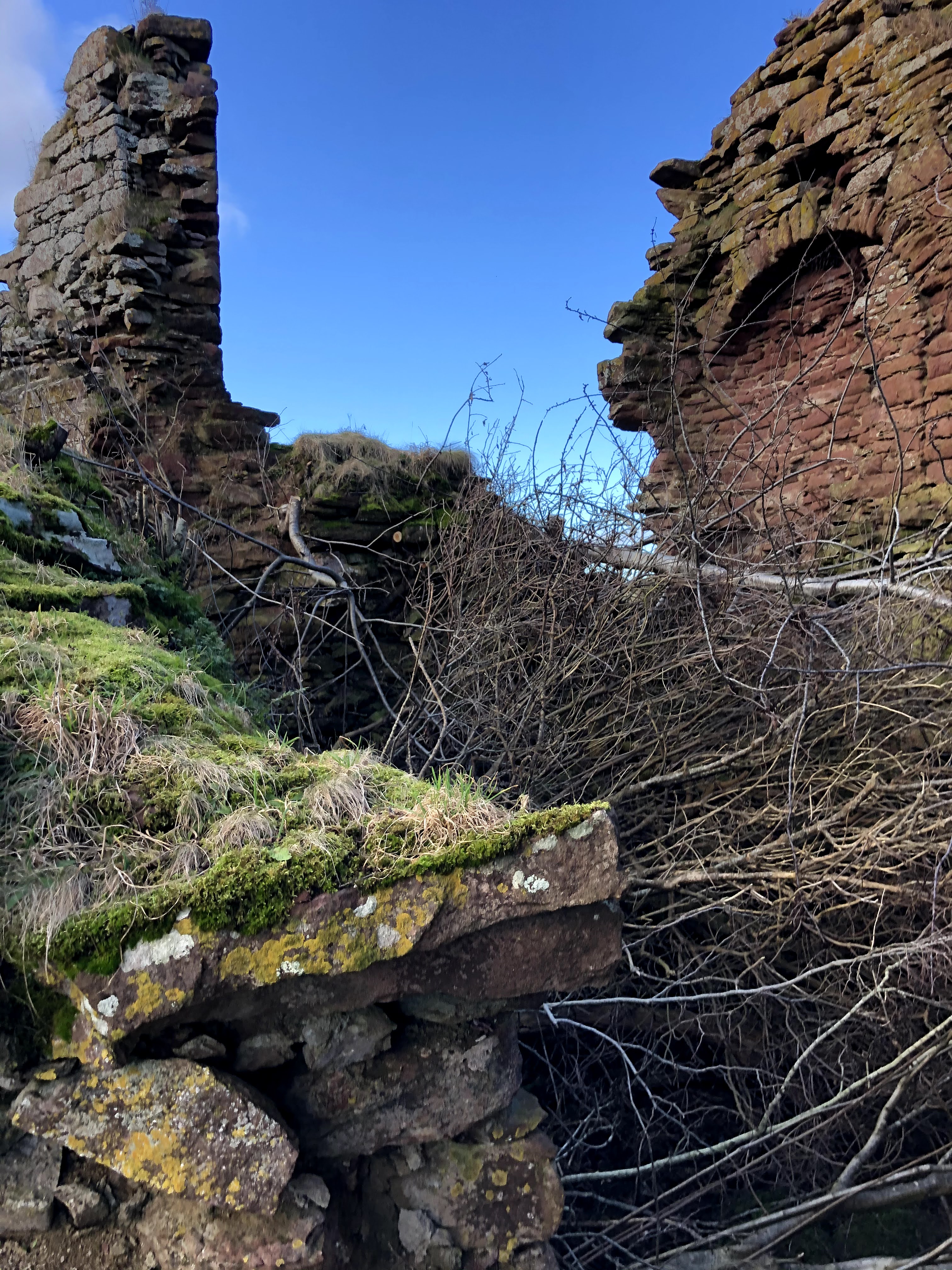
The site is not maintained, is surrounded by a rusty barbed wire and has unfortunately suffered from a tree collapsing through one of the main walls. It is accessible if you are feeling adventurous, and it is possible to gain entry – however – bear in mind it would be a nightmare for emergency services to attend, so be careful!! Also not recommended for parents and carers of young children that like to clamber… the walls really are very weak.

While I was thrilled to find a ruin so close to home, I will not be rushing back to Vayne Castle. The site is not easily accessible, and I was nervous about the wee one and the dogs careering around a building that looks to be on its very last legs. Unfortunately you need to be up close to admire its stature and imagine its former legacy. Just not one for the family…

Dunnideer Castle and Hillfort

Visited in May 2021, Dunnideer Castle and Hillfort is located on the outskirts of Insch, Aberdeenshire. Noted on the map below with a yellow pin is the small car park at the bottom of the hill, with space for 4 or 5 cars. This is on Western Road, as you head west (oddly enough) out of Insch.

The remains of the existing castle date back to around 1260 AD, although the site has been utilised since the late 800s. However, the Hillfort has provided evidence of a settlement possibly as early as 550BC. Driving into Insch, the remain of the castles stand proudly on the hilltop, and it seems an obviously defensive position, with a full 360 degree view of the surrounding countryside for miles around.

It is not immediately apparent who maintains the site, but Historic Environment Scotland have the following website which provides extensive information about its history and the links to the surrounding area – https://canmore.org.uk/site/18128/dunnideer

A small but attractive woodland clusters at the bottom of the path, and there is clear signage directing visitors up the hill to the ruins. Although well-maintained, and not particularly long, the path is steep. While the smallest child and dogs scampered ahead, it took a little puffing to get me to the top. Certainly not suitable for pushchairs, wheelchairs or anybody with significant mobility or health issues.

As evident from the pictures, not much of the castle remains – and that which does is far from ornate. Nonetheless, the setting is as impressive as any in Scotland and the youngest seemed very taken with the site, skipping around the tussocks and trying to figure out which way the ‘princess’s bedroom window would have pointed’.

Dunnideer Castle is a little jewel in the Aberdeenshire countryside; what it lacks in size it makes up for in scenery. Free to visit, and well-maintained, it is well worth a detour if you happen to be driving in the local area. The walk up the hill will clear out the cobwebs, if nothing else.

Dunnottar Castle

Visited in April 2018, Dunnottar Castle was one of our first forays into old abodes in Scotland.

The castle is located a couple of miles to the south of Stonehaven, and just off the A92, which is the road that connects the town, Angus and Dundee (hugging the coast). The castle is also easily accessible from the A90, which is generally a quick road to drive.

The name Dunnottar translates from the Gaelic Dùn Fhoithear, or ‘Fort on the shelving slope’. The earliest written records of the site date back to around 681AD, but the remaining buildings were erected in the 15th and 16th century. Strategically situated on the east coast, and well placed for defence, the castle has been prominent in Scottish history, up to and including the Jacobite rebellion.

Undiscovered Scotland provide a detailed account of the history of the castle, plus the importance of its geography.

https://www.undiscoveredscotland.co.uk/stonehaven/dunnottarcastle/index.html

The site has been owned by the Cowdray Family since the 1920s and remains in their possession but run as a visitor site. Their website is https://www.dunnottarcastle.co.uk and has up to date information on tickets and opening times. At the time of writing, adult tickets were £8 while children were £4.

There is a large car park close to the castle (marked with a red pin on the map above) with toilets and food vans on site. While the paths leading up to and within the castle were all well maintained, the path to the site itself is not suitable for wheelchairs, buggies, very small children or those with mobility issues, given the 200 odd steep steps. It’s almost as if the original builders did not anticipate Dunnottar’s later life as a tourist attraction.

A personal point of interest are the large stables within the castle grounds – I would have been very interested to see how the horses and ponies navigated the route up and down!

Dunnottar is a must-visit for anyone with an interest in Scotland’s castles. It’s the perfect mix of history, geography and stunning scenery, which the owners have capitalised upon as a well-run visitor attraction. If you have time, nip down to Stonehaven. We can recommend the Bay Fish and Chip Shop (award-winning!) and Aunty Betty’s (for ice creams as big as your head).

Arbroath Abbey

Visited in December 2020, the Abbey is currently open to visitors Friday-Monday, although the visitor centre is closed due to COVID-19 restrictions.

Nestled in the town centre of Arbroath, in the county of Angus.

The four corners of the Abbey

Built with local red sandstone, the Abbey was founded in 1178 and consecrated in 1197. Abandoned and left to ruin in the late 1500s, much of the building was pilfered to provide building materials in the town.

A brief overview of the Abbey’s history is detailed on the travelling savage blog – https://www.traveling-savage.com/2018/07/25/arbroath-abbey-scottish-independence/

Pictures of the inside areas (which were inaccessible when we visited) and links to relevant books can be found on the Undiscovered Scotland site – https://web.archive.org/web/20041010020927/http://www.undiscoveredscotland.co.uk/arbroath/arbroathabbey/index.html

Arches, arches… everywhere!

The site is now maintained by Historic Environment Scotland. Admission is free, but as noted, no current access to the visitor centre or the inner areas (and we will probably return to enjoy these when possible).

Accessible overall, the site is flat with well maintained grounds and paths. Although there is not a designated car park, there is plenty of street parking roundabout, plus town centre and supermarket parking within five minutes walk. It’s unclear whether dogs are welcome, no signage either way. My little one loved exploring the nooks and crannies on site, but needed frequent reminding not to go climbing, which might prove irresistible for some kids!

Plenty for the kids to explore

Invermark Castle

Visited in January 2020, Invermark Castle sits at the head of Glen Esk, most easily reached by taking the Edzell turn off from the A90. The roads are windy and the drive from the dual carriageway to the closest car park (marked by a red pointer on the map) is around 40 minutes. The walk from the car park to the castle takes less than 10 minutes.

A castle has been on the site since the 14th century, with the current building erected in the 16th century and abandoned in 1803. Designed as a three storey tower, there were also outbuildings surrounding, the foundations of which can still be seen. Stone from these buildings was apparently pilfered to construct the nearby parish church.

Privately owned, it is not possible to enter the castle. However, the land roundabout is well-maintained and there are no restrictions in place to stop those interested having a close look.

It is well worth walking beyond the castle; further journeying down a well maintained road eventually leads to some friendly ponies, past some buildings associated with the nearby hunting lodge, alongside a ruined church and culminates at Loch Lee, which is both expansive and atmospheric. Although we stopped at the loch shore, the map indicates a path that disappears far into the glens.

Cairns Castle

Visited on the last day of October 2020, this wee ruin is at the bottom of a (really, really) narrow single track lane, off the A70, a few miles drive from Kirknewton. It’s not the easiest to find, so I’d recommend Google mapping once you are in the area. 

There is a reasonably sized car park on the right as you head towards the castle, next to a fishing hut. The last half mile of road appears to be on private land… At least, through a closed gate guarded by an attentive Collie! The road is in good condition though, and was frequented by walkers, so no concerns about access. 

A medieval Towerhouse, constructed in the mid-1400s and the seat of the Crichtons of the Cairns. From searching online, I’m led to believe the original structure was far larger than that which remains now. Other than information that the bulk of the building was removed around 1870, I’ve struggled to find much about its history.

http://www.stravaiging.com/history/castle/cairns-castle provides some additional information, while canmore.org.uk/site/49093/cairns-castle has some great aerial views. If there are links with more details, please let me know. 

It’s also not immediately apparent who maintains the site, as it appears to sit in the garden of the farmhouse next door! There is no obvious entrance to get into the surrounding grounds (without clambering through some ones garden), although the walls are low enough to see over and the path goes very close.

Overall, unfortunately Cairns Castle was entirely underwhelming. We visited it as part of a much larger tour round castles in the area, so it was a fine opportunity to tick it off the list. While we won’t be rushing back, the reservoir it sits on (Harperrig) looks like a good place for a dog walk and there were some cute residents round about to admire. 

Abbotsford

Visited on a dreich afternoon, 1st November 2020. Abbotsford House and Gardens sits beside the River Tweed, a five minute drive from Galashiels and accessible off the A6091. 

Bought as a modest farm steading by Sir Walter Scott in 1811, the grounds and house were subject to extensive renovation and development by the author over the course of the following 15 years. Although open to the public since 1833, Scott’s descendants remained in the house until 2004. The Abbotsford Trust now manage and maintain the site, and it is considered one of Scotland’s finest tourist attractions. Further details of the history of the house (and plans for it’s future) can be found here… 

https://www.scottsabbotsford.com/

We undertook an audio tour of the house, narrated by none other than Sir Walter Scott himself… Access to the house is limited to the downstairs, but highlights include Scott’s study, library and his armoury collection. Thousands of books line his shelves and the library looks out over the grounds. While literary inspiration seems almost inevitable in this glorious setting, the audio tour tells the sad tale of a man who became beholden to his writing, to clear the debts associated with creating such a grand home. 

Admission to the house and gardens is paid, with adult ticket priced at around £11 and children around £5 (as at November 2020). An exhibition centre and ticket office is located a short walk from the house, also hosting a cafe, toilets and a shop. Well maintained wall gardens are situated next to the house, alongside a small children’s play park and extensive walking paths around the estate.

The car park and the grounds are well maintained, with disabled access across the whole site. 

I must admit, I prefer castle ruins to grand homes. Nonetheless, a visit to Abbotsford is worth the time and expense. Poor weather stopped us from enjoying the park and the grounds, but I believe we could have easily spent a full morning or afternoon on site, soaking up the ambience and making the most of the extensive surroundings and interesting exhibits. 

Design a site like this with WordPress.com
Get started